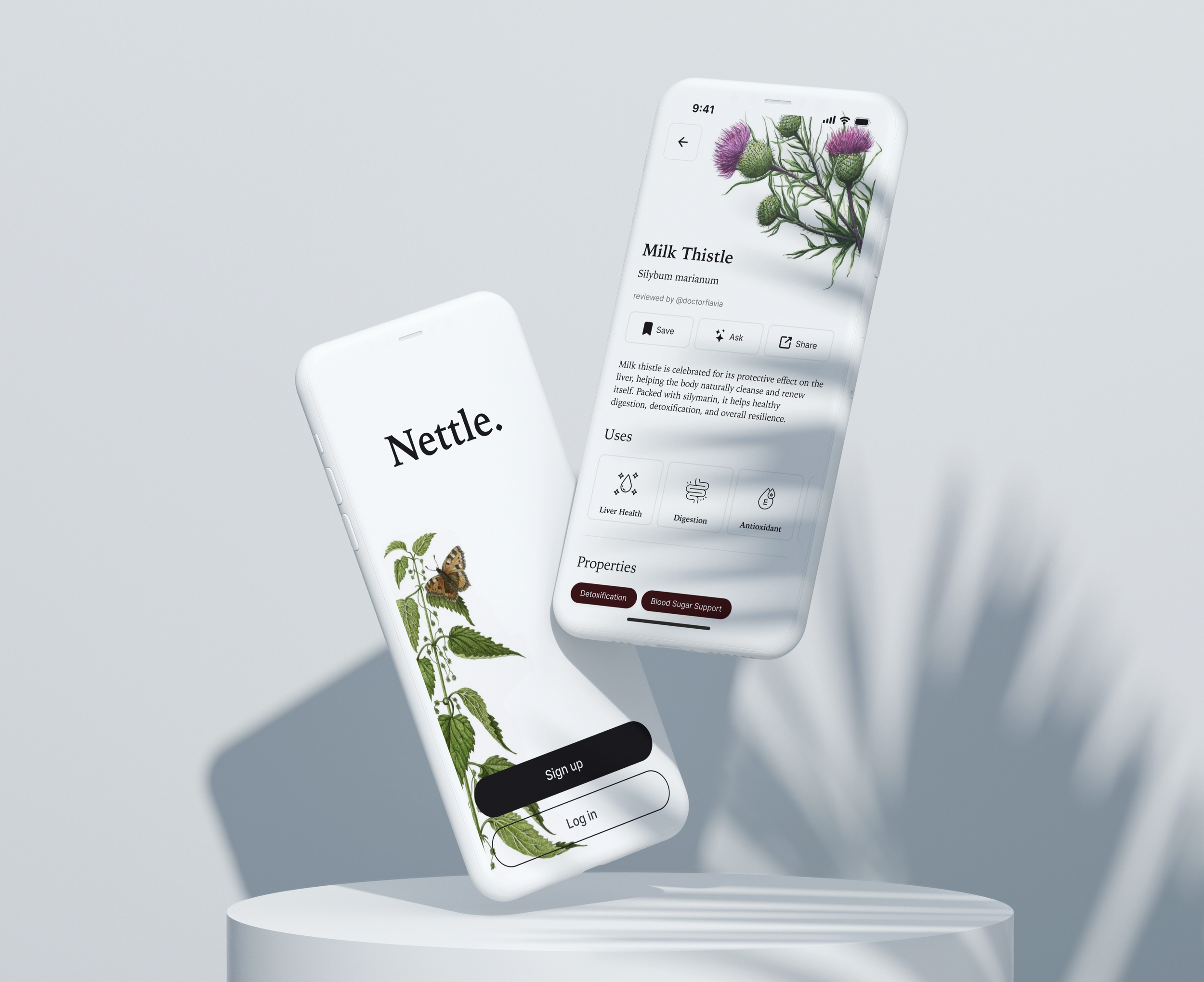
Nettle
Bridging ancient herbalism and modern AI to empower everyday health decisions 🧚
Overview
Nettle is an AI-powered herbalism assistant designed to make holistic care more approachable, educational, and personalized. Grounded in user research with wellness seekers and herbal enthusiasts, the project works to instill user confidence in holistic healing. Through an intuitive interface featuring botanical visuals, symptom-based recommendations, and guided learning, Nettle empowers users to explore plant-based remedies safely and meaningfully.
Project Type
UX Design, UX Research, Brand & Strategy
Duration
1 Month
Tools
Figma, Google Forms
How might we…
make herbal knowledge more accessible and trustworthy through an intelligent, conversational interface?
Quick Stats
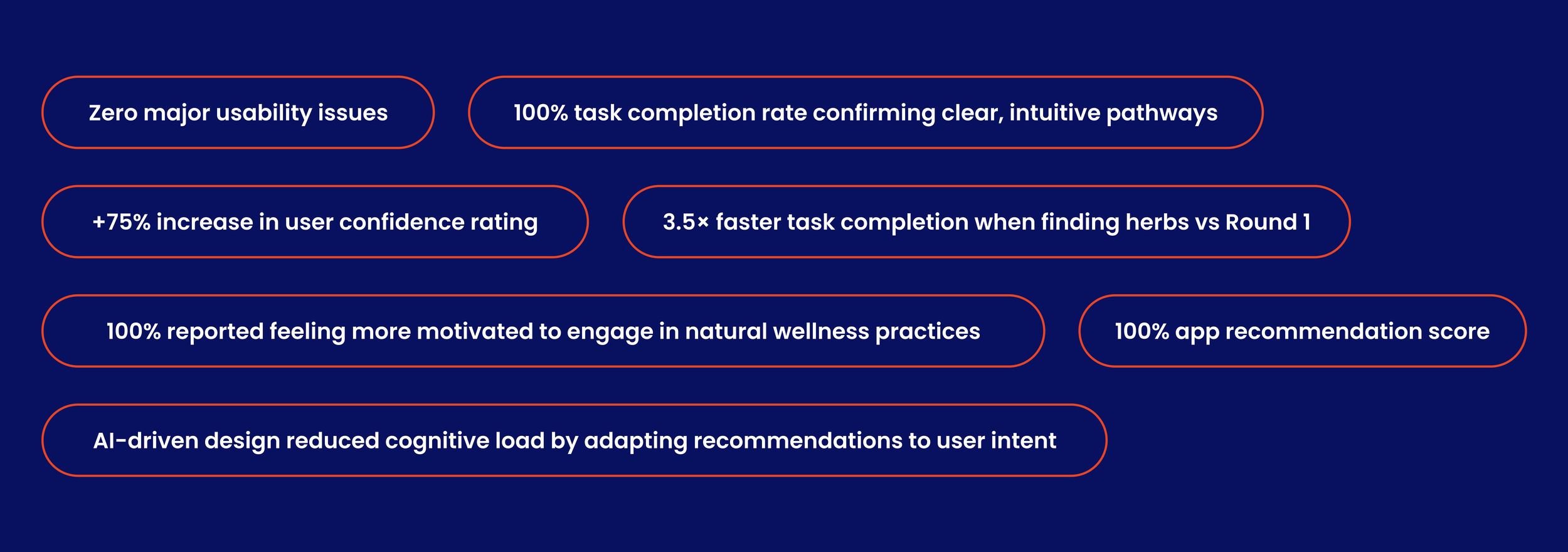
+75% increase in user confidence navigating and selecting herbal remedies after testing.
100% task-completion rate across all key user flows, confirming intuitive navigation and clear learning pathways.
100% of participants described the app as “beautiful,” “intuitive,” and “easy to use,” reinforcing brand trust and approachability.
AI-driven design strategy reduced cognitive load by adapting recommendations to user intent and herbal literacy level.
$37B+ global herbal market projected to grow 6.3% annually — positioning Nettle as an opportunity to bridge wellness education and digital health AI.
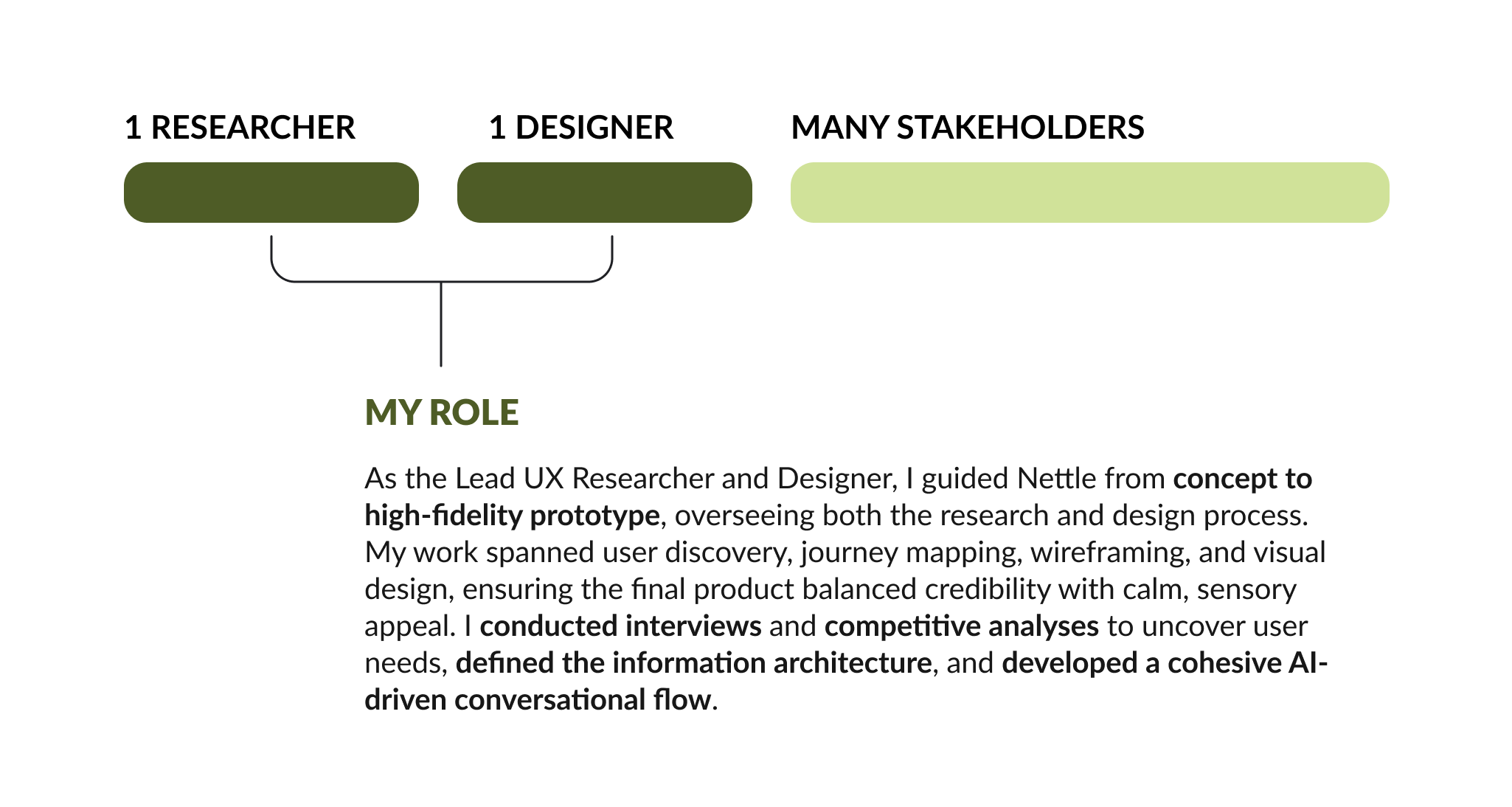
Role
Overview
What is Nettle?
Nettle is an AI-powered herbalism assistant designed to make holistic care approachable, personalized, and rooted in evidence-based tradition. Grounded in user research with wellness seekers and herbal enthusiasts, Nettle works to instill confidence in plant-based healing. The app offers guided recommendations, rich botanical profiles, and symptom-based insights that empower users to explore natural remedies safely and meaningfully.
Challenge
The Problem at Hand
While interest in herbal remedies is growing, most people struggle to navigate the overwhelming and unstandardized world of holistic care. Wellness seekers want to take charge of their health naturally, but they face fragmented information, confusing terminology, and a lack of trustworthy, personalized guidance.
Opportunity
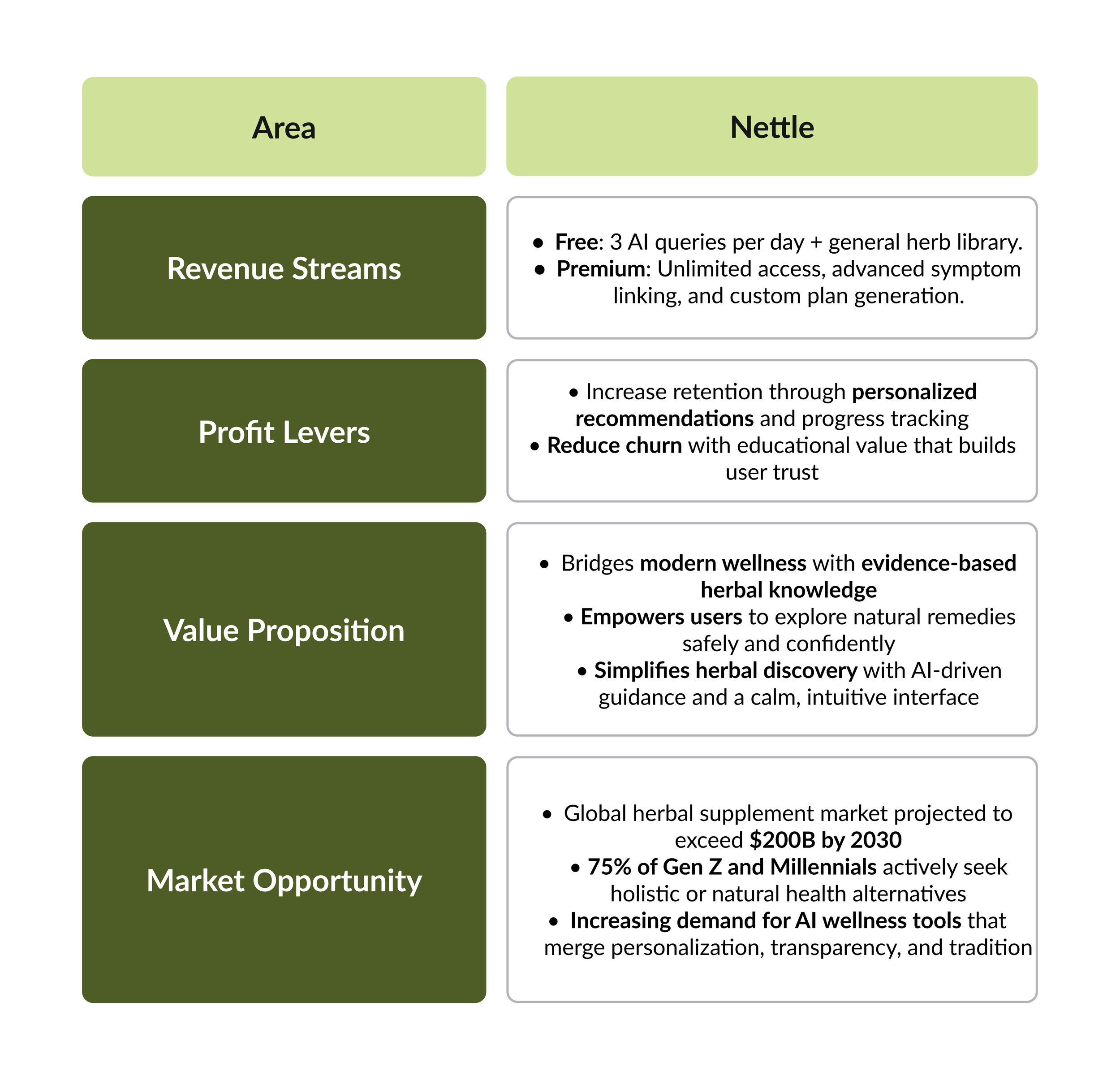
Business Proposition
Nettle combines AI personalization with accessible, evidence-based herbal education. Its hybrid freemium model and potential partnerships with ethical wellness brands position it for sustainable growth, while striving to provide an evidence-based, healing experience.
Research
Methods
I followed a mixed-methods research approach to uncover how users engage with and trust herbal wellness information. This process combined qualitative interviews alongside quantitative surveys. In parallel, I conducted secondary research (market analysis, competitive benchmarking, and academic review of herbal efficacy) to ground the design in insights. Synthesizing these findings through affinity mapping and thematic analysis allowed me to define user personas, key pain points, and opportunity areas that shaped Nettle’s core experience and AI-driven guidance.

Interviews
Our Target Users
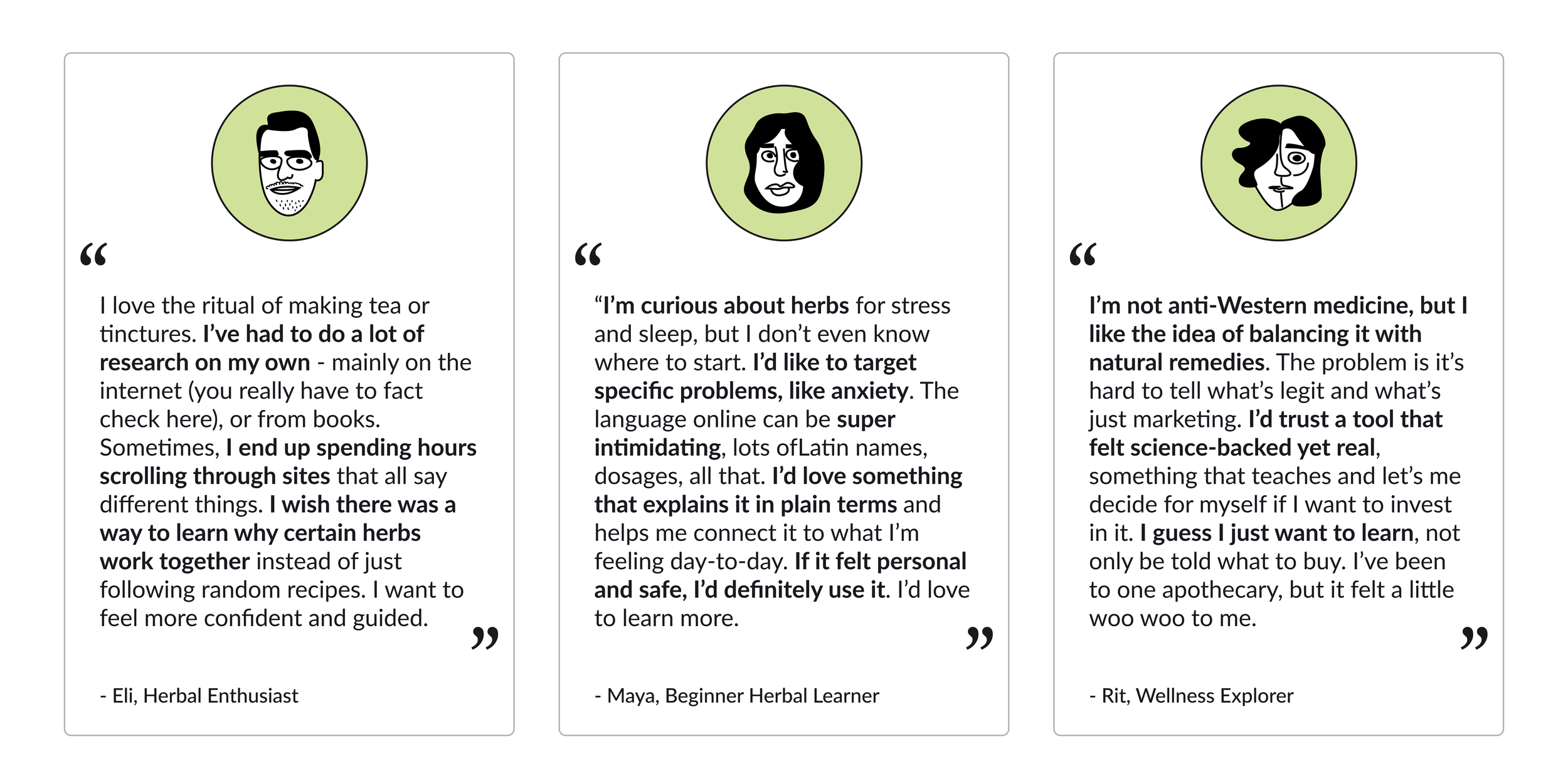
To better understand how people learn about and engage with herbalism, I conducted six 1:1 user interviews with participants ranging from curious beginners to experienced herbal enthusiasts. These conversations helped uncover barriers around trust, accessibility, and confidence in using herbs
Survey
Quantitative Research
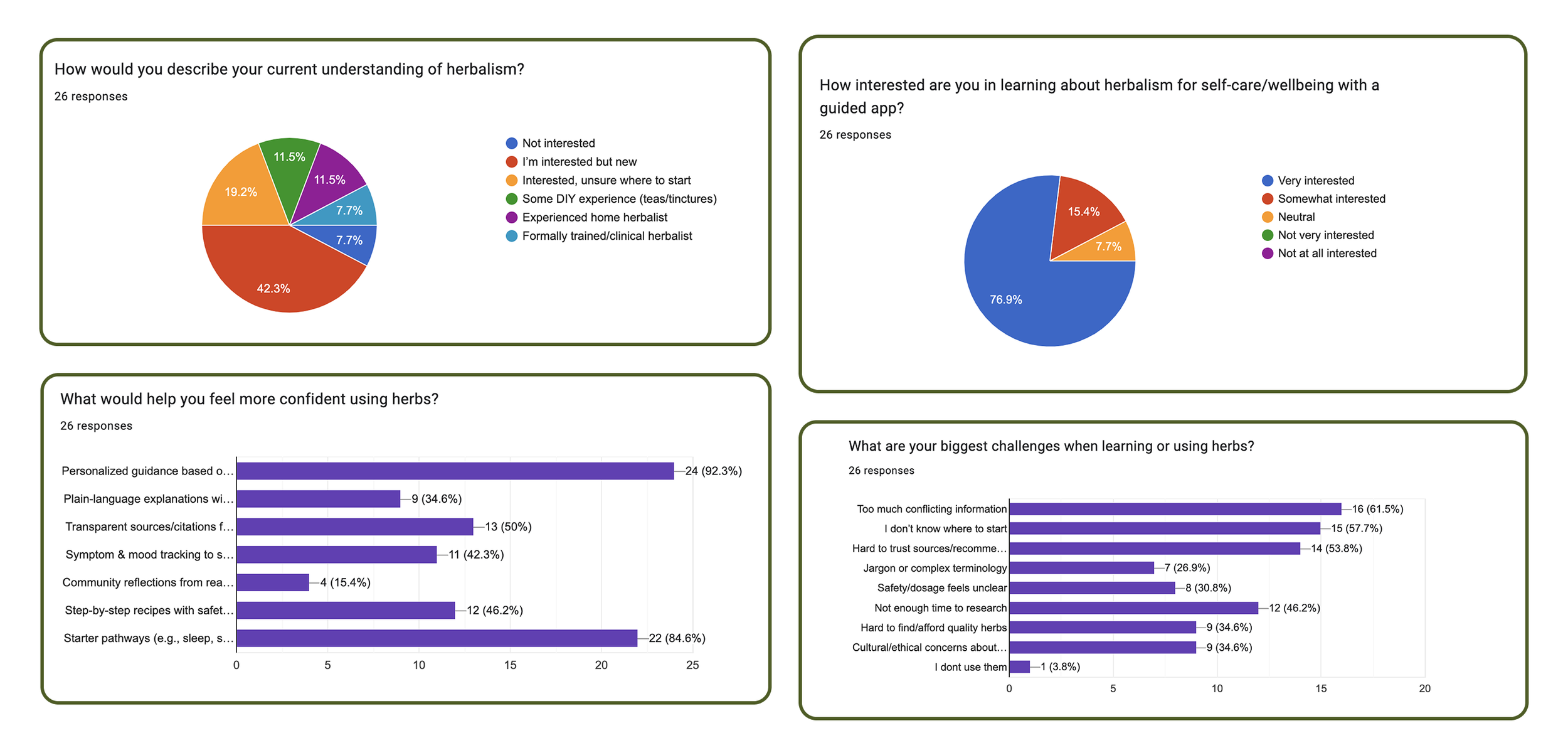
To validate early hypotheses from interviews, I conducted a quantitative survey with 26 participants aged 22–40 to understand how people learn about and engage with herbalism. Questions focused on herbal knowledge, trust, learning preferences, and confidence barriers.
Personas
Our Target Users
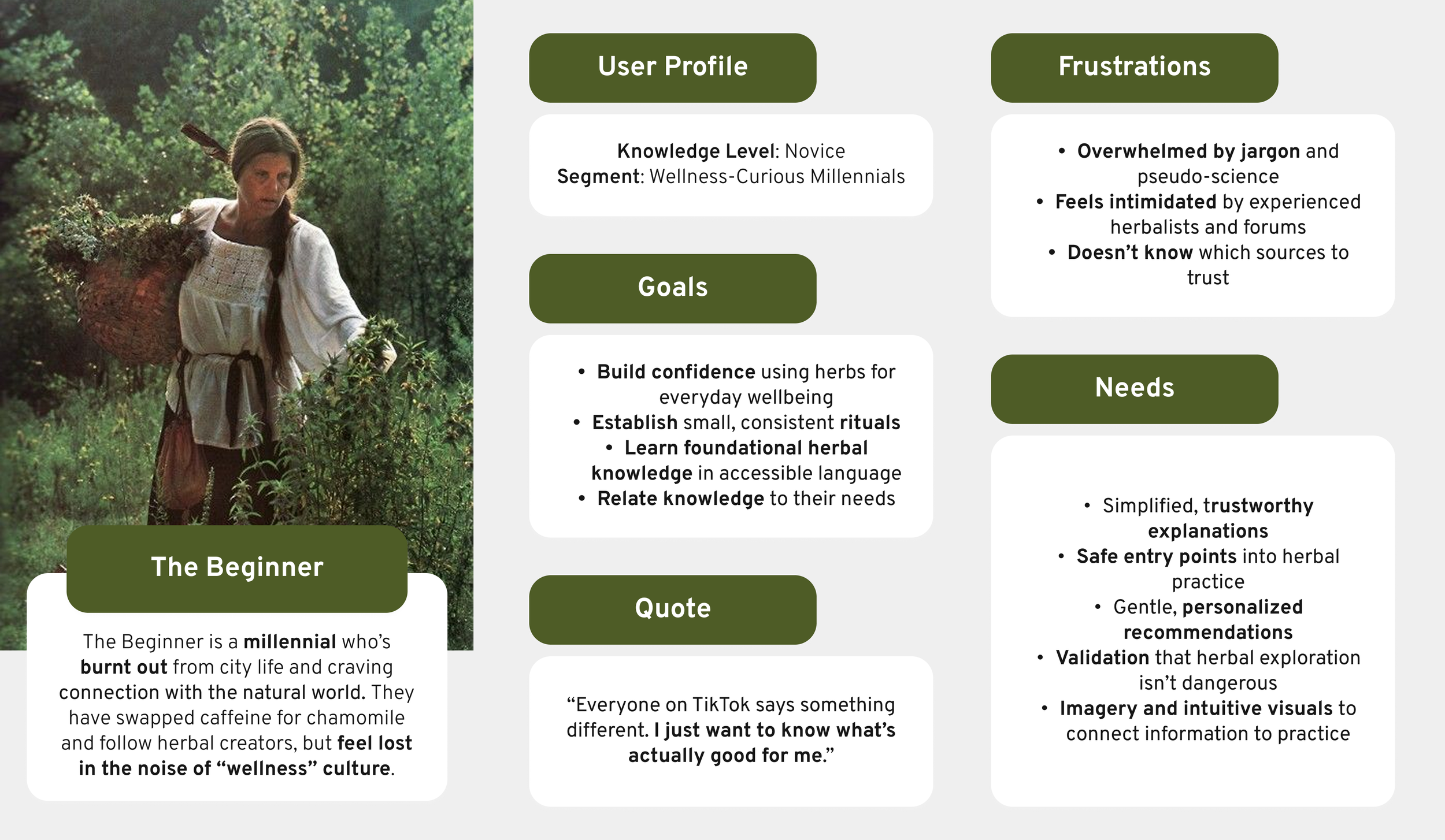
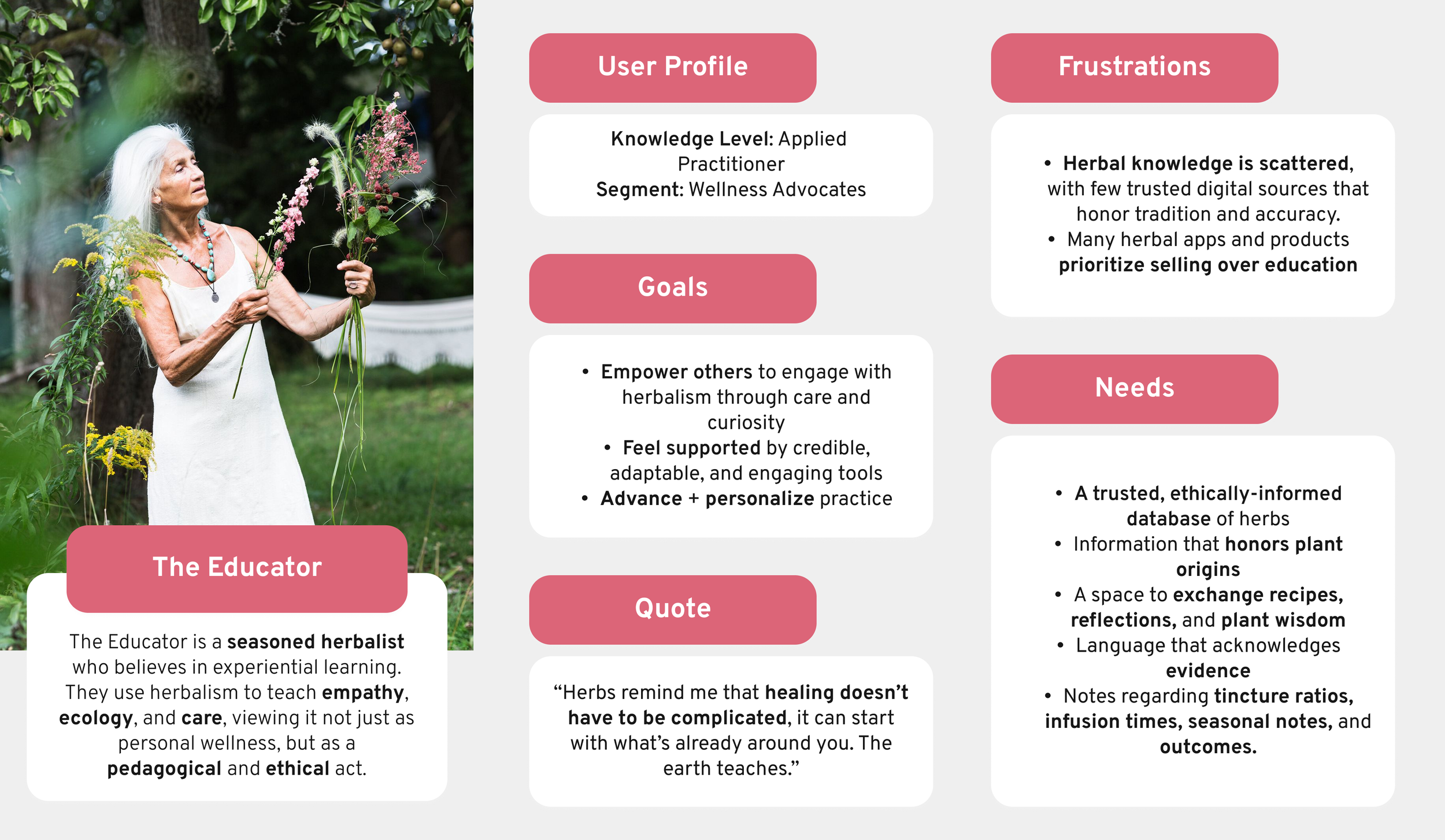
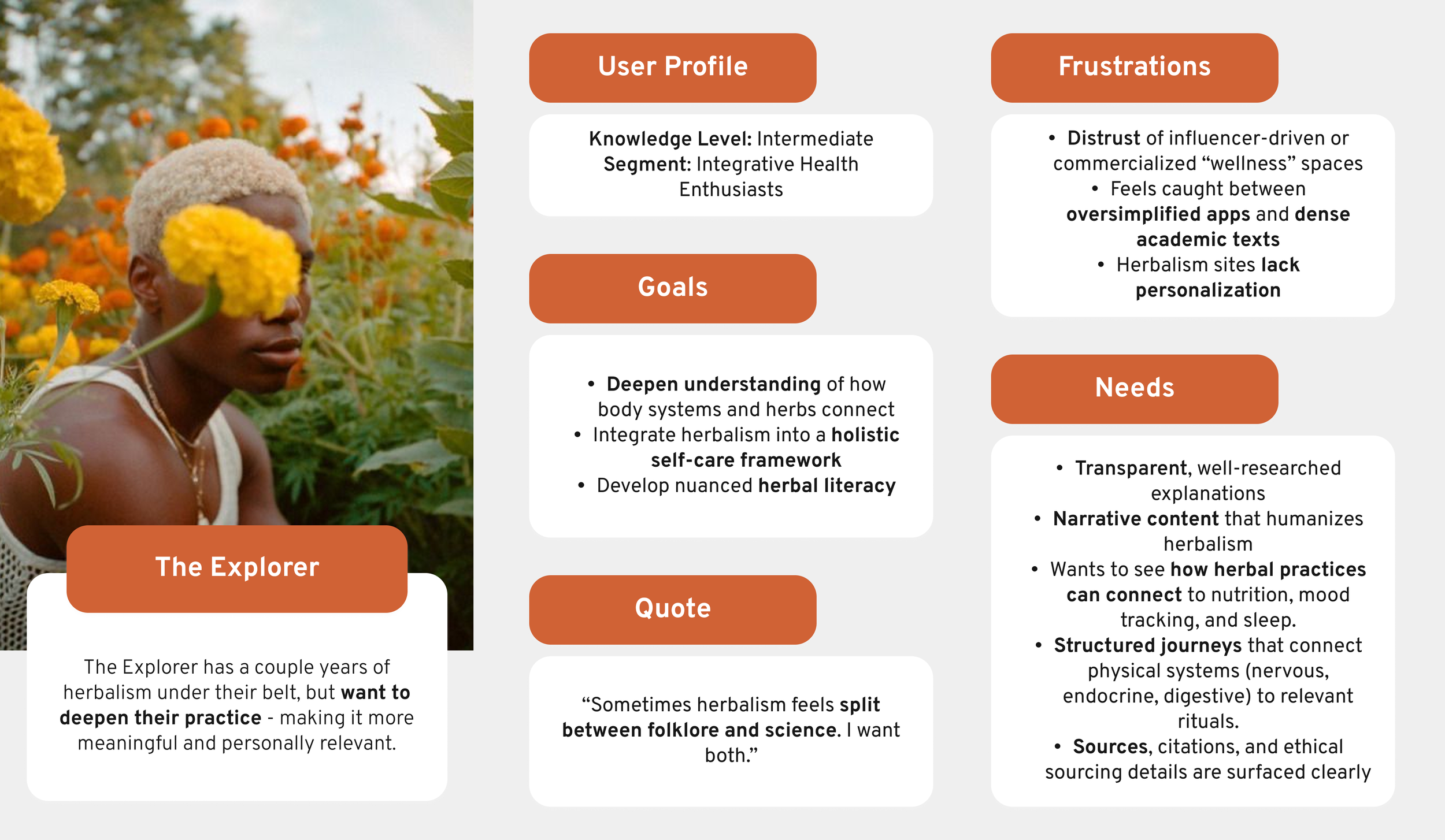
To ground the design in user behavior, I synthesized findings from six user interviews and secondary research into three primary personas, each representing a distinct stage of herbal literacy and motivation.
Landscape Analysis
Looking at What Exists
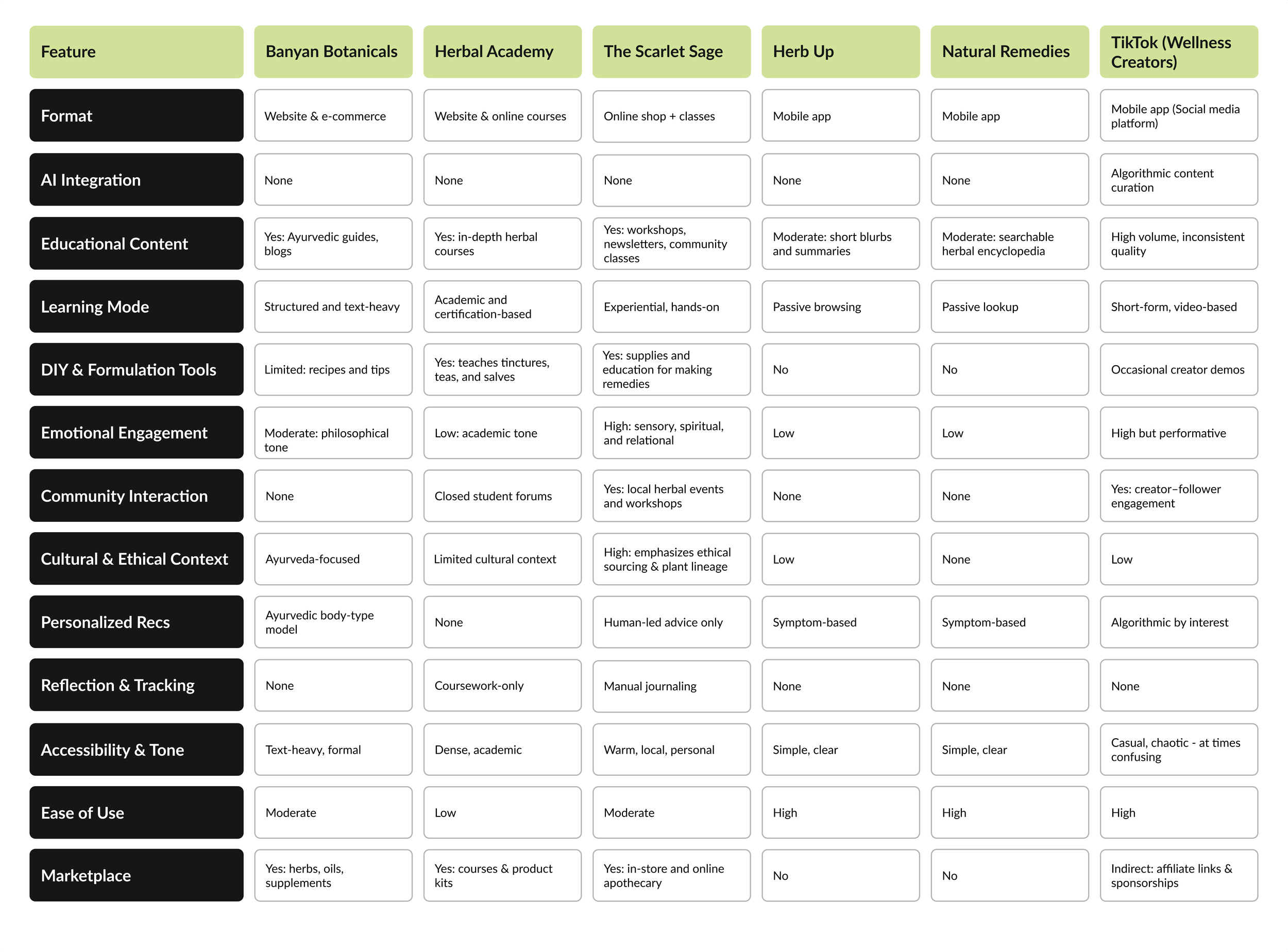
The herbal learning ecosystem spans commerce-driven education (Banyan, Herbal Academy, Scarlet Sage) and self-guided or algorithmic discovery (Herb Up, Natural Remedies, TikTok) but none unite emotional learning, reflection, and credible AI guidance.
Findings Summary
Key Takeaways
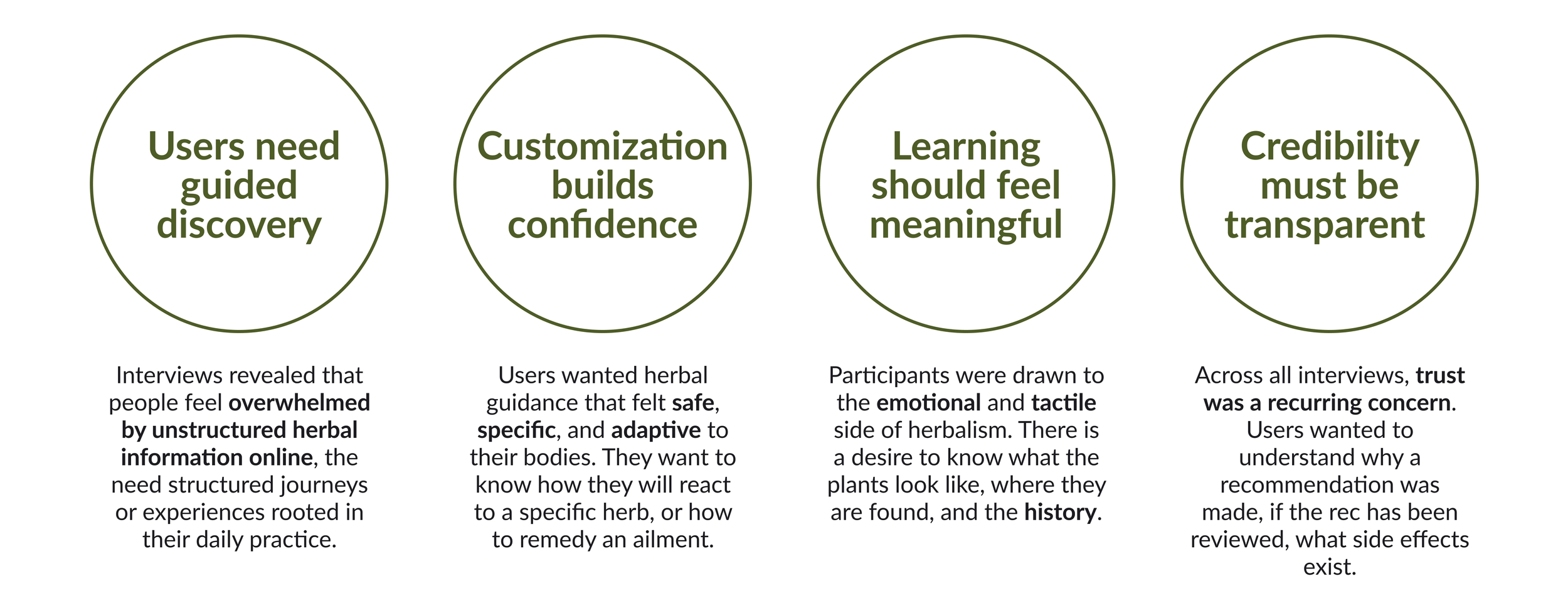
Through six user interviews, competitive analysis, and secondary research, I uncovered that most people interested in herbal wellness feel curious but overwhelmed, lacking trusted, accessible guidance. While existing platforms offer either dense academic content or superficial advice, users wanted something personalized, credible, and grounding.
User Flow
Mapping the Journey
After identifying key user goals from research, discovering herbs, learning through AI guidance, and being able to easily explore guided healing pathways, I created a detailed user flow to map how someone would navigate Nettle.

Wireframes
Early Iterations
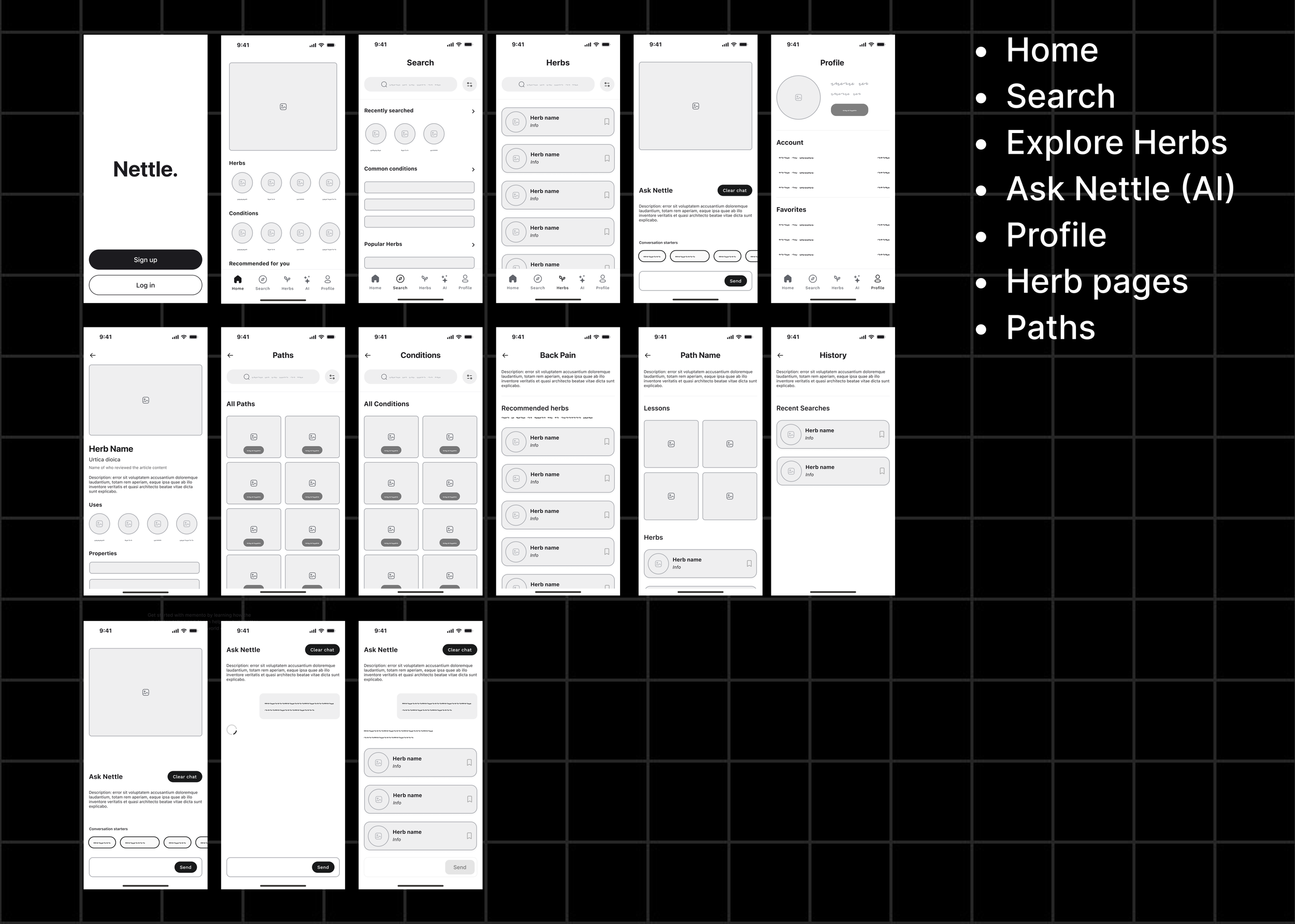
With the user flow established, I translated the journey into a series of low-fidelity wireframes to visualize key interactions and information hierarchy. My focus was on designing a clean, guided experience where users could easily ask the AI questions, explore herbs, and follow curated learning pathways.
Gathering Feedback
First Round of Testing
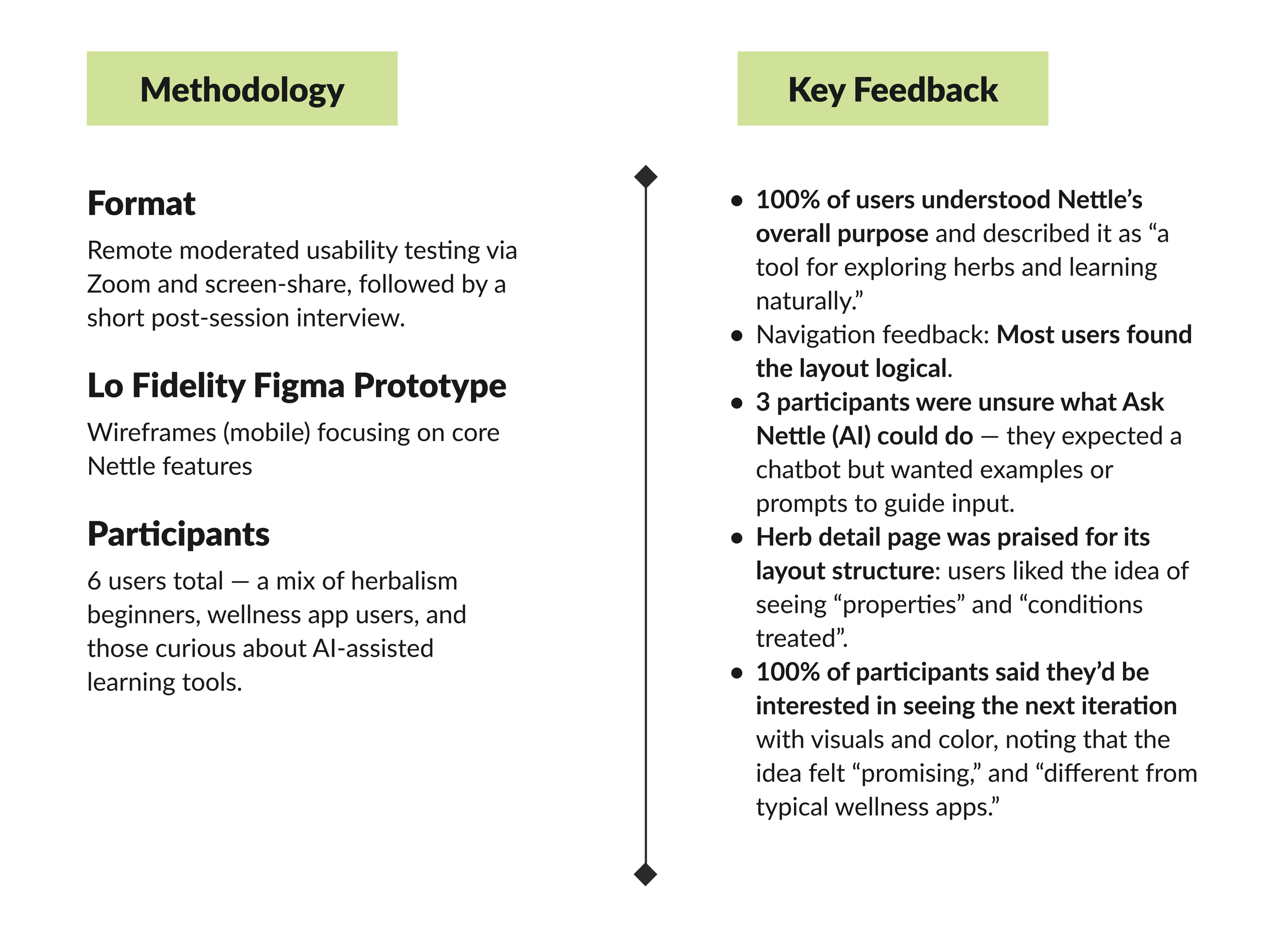
I conducted a first round of usability testing with five participants to evaluate how intuitively users could navigate Nettle’s wireframes and complete core tasks, such as asking the AI a question, finding an herb, and selecting a relevant learning pathway to follow.
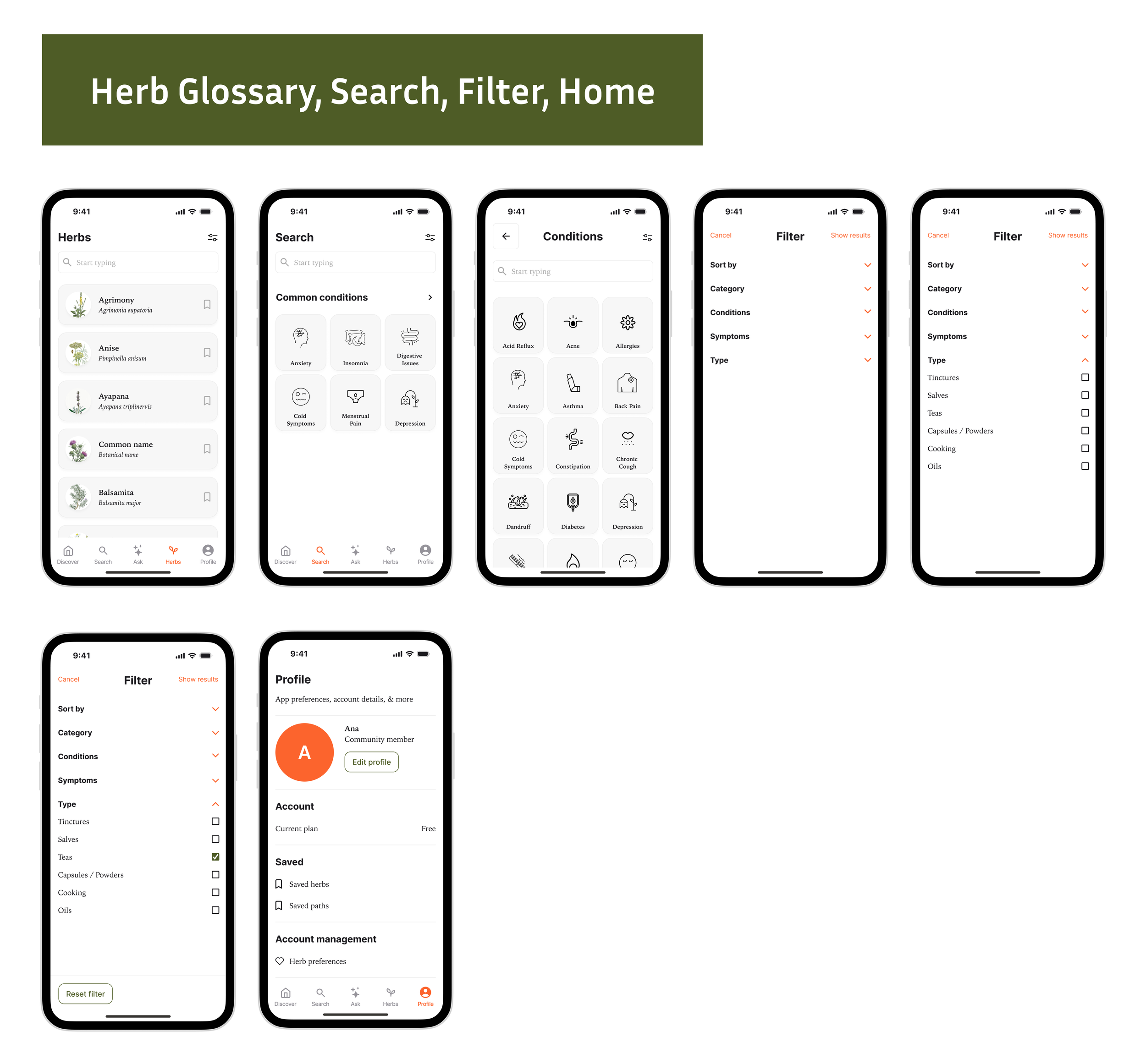
Final UI
Key User Interfaces
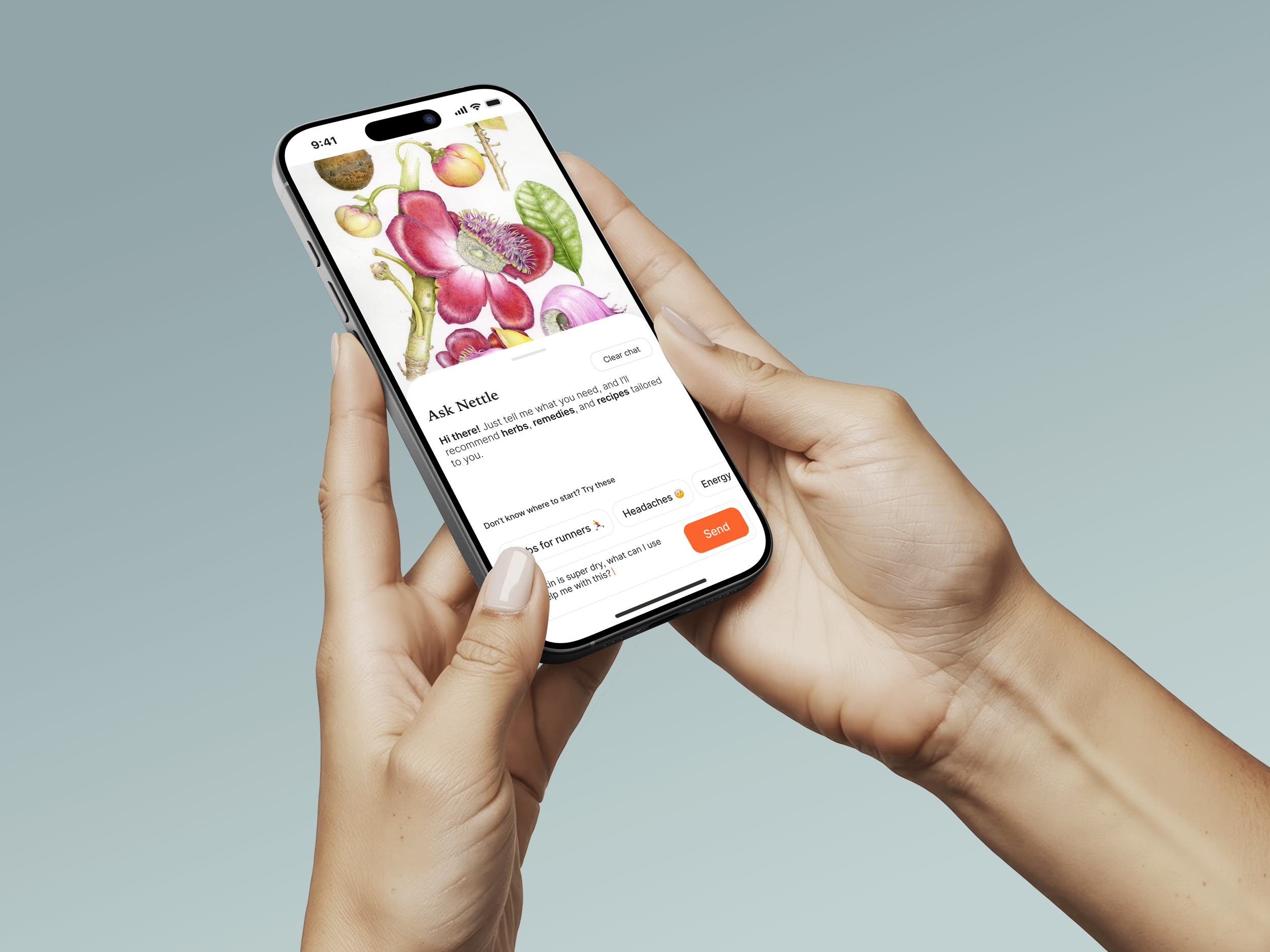
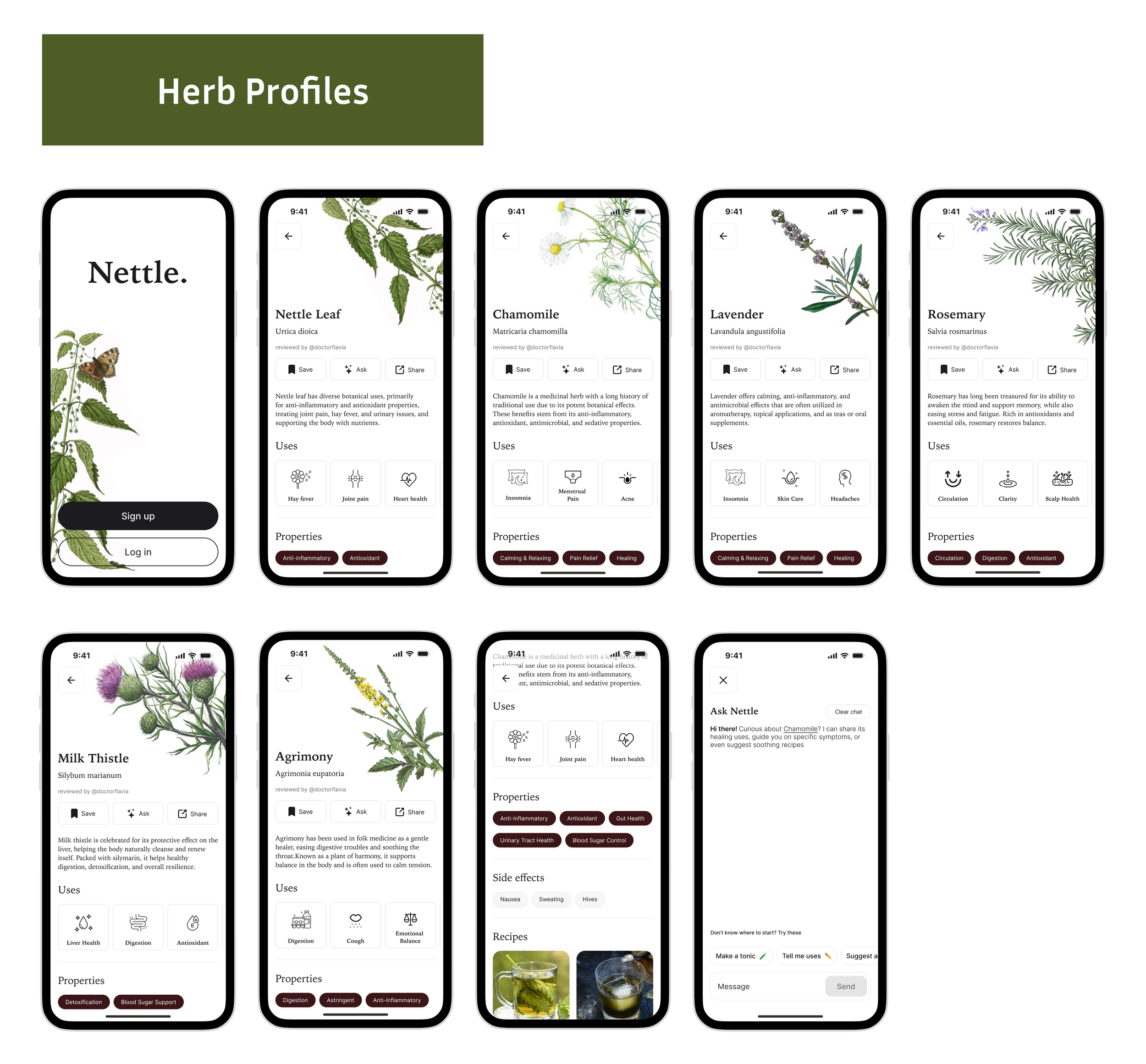
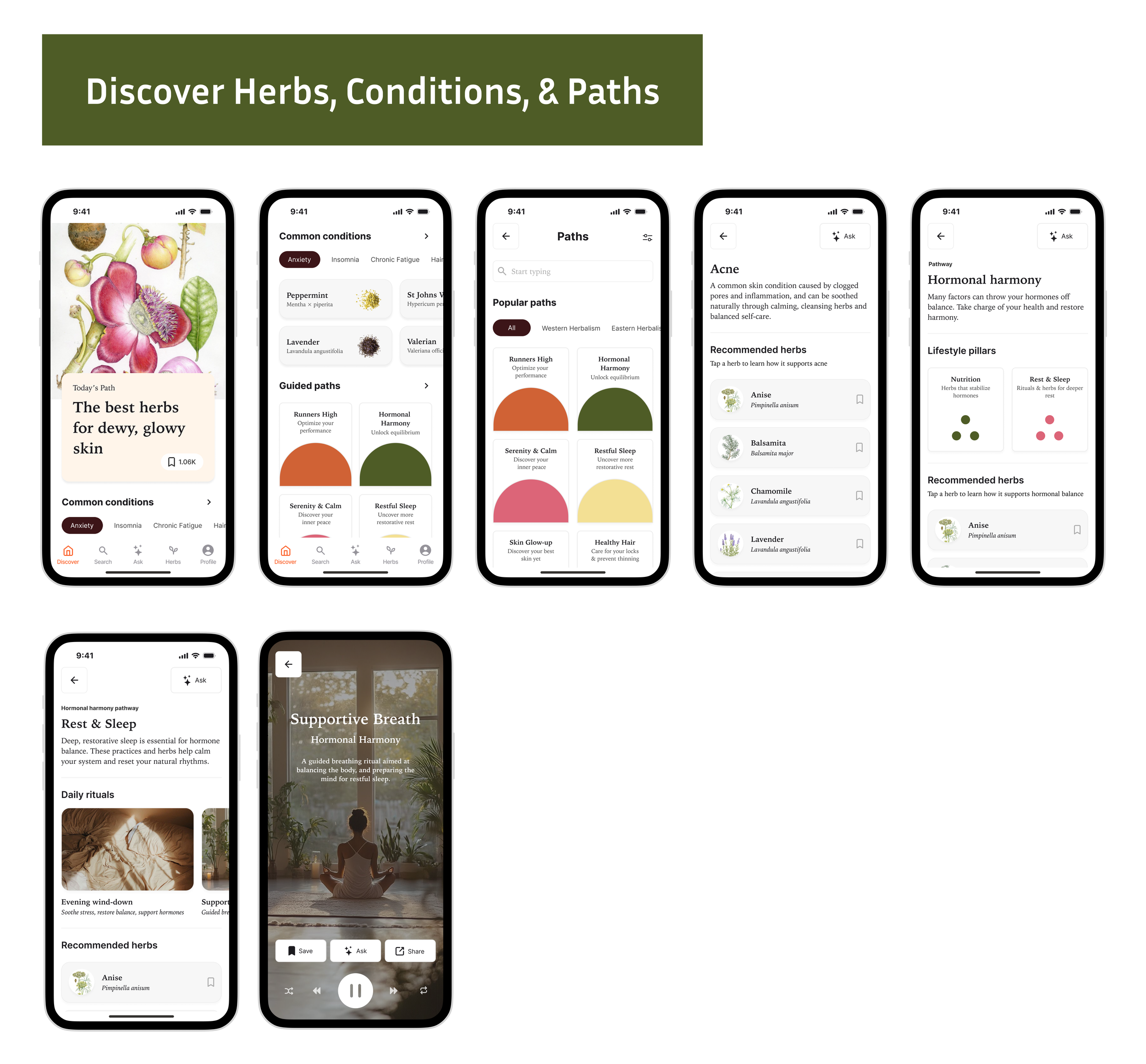
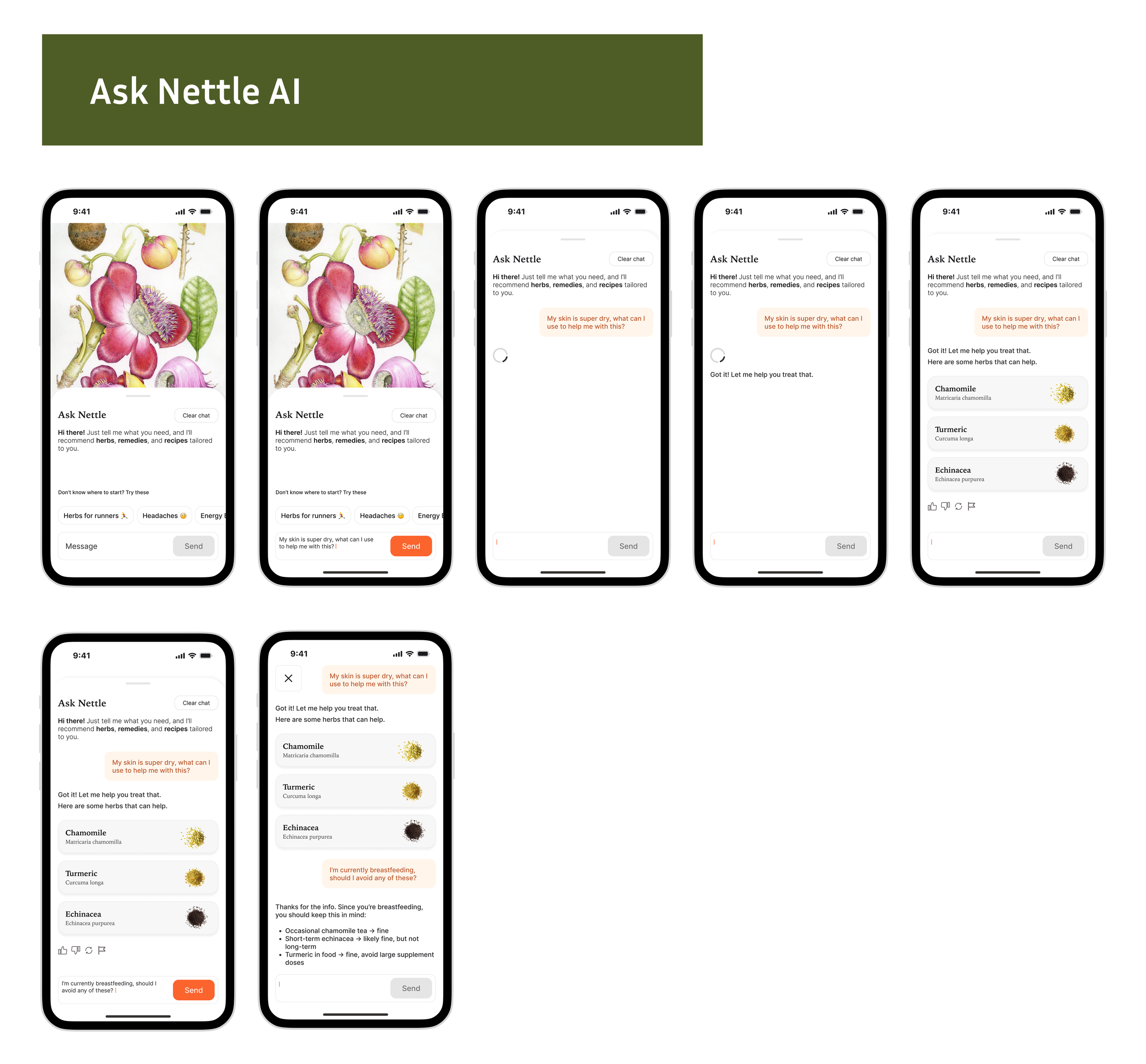
The final interface brings Nettle to life as a calm, intuitive, and trustworthy learning companion for herbal wellness. The design pairs soft botanical tones, generous white space, and accessible typography to create an environment that feels is credible and engaging.
Design System
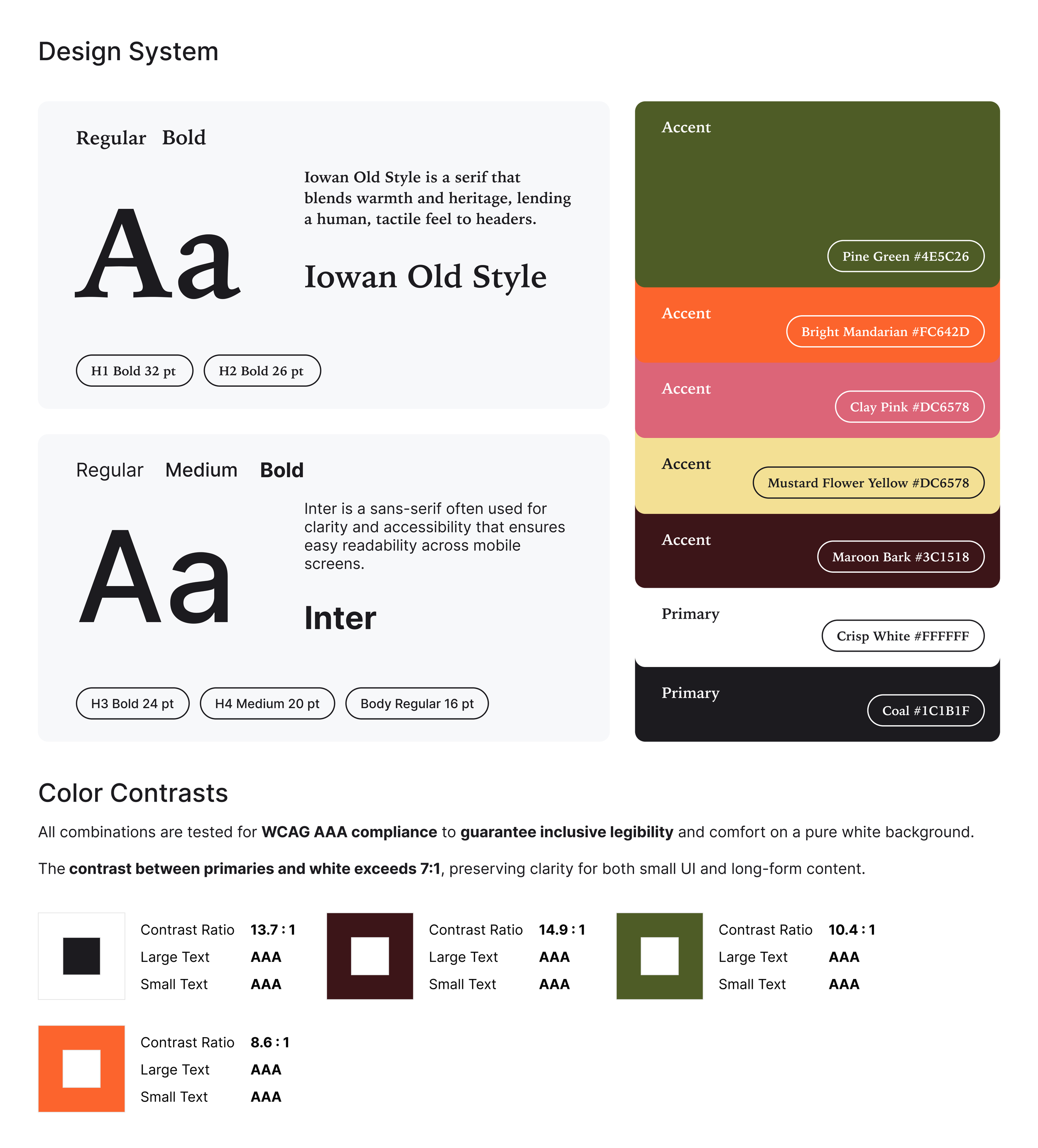
Designing for Consistency
I designed a unified visual language that ensured that Nettle established clear foundations for typography, color, and accessibility, all meeting WCAG AAA contrast standards.
Usability
Testing
Second Round Testing
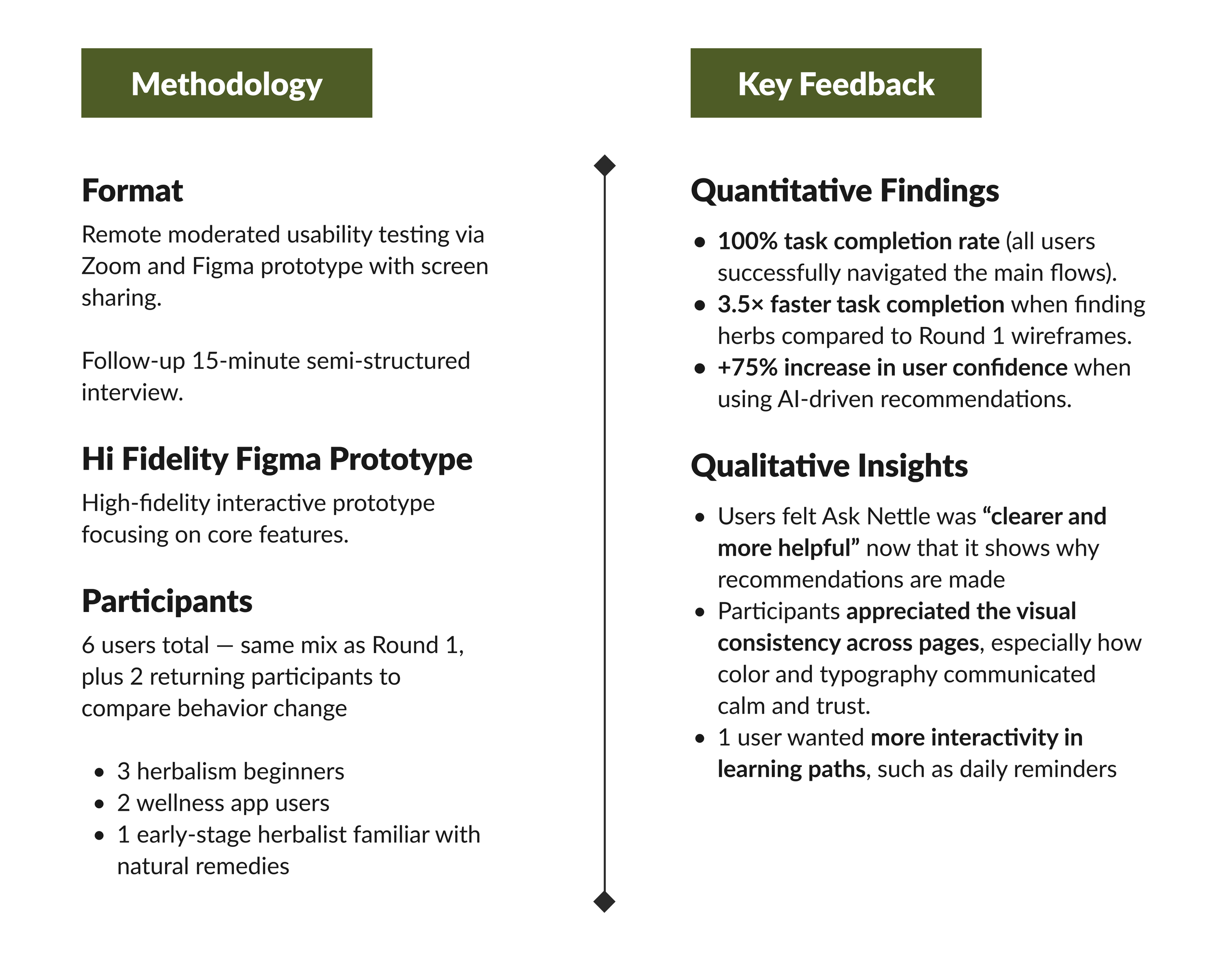
In the final round of testing, I evaluated the high-fidelity prototype with six participants to assess clarity, navigation, and overall learning experience. Users successfully completed key tasks, asking the AI questions, exploring herbs, and following learning pathways.
Outcomes
Limitations
Acknowledging Barriers
Limited testing scope: Usability testing was conducted with a small group of participants (primarily wellness-curious users) rather than a fully diverse audience including certified herbalists or medical professionals. Future iterations should include broader user segments to validate accessibility and accuracy across knowledge levels.
Simulated AI Agent: Due to time constraints, the AI interaction and symptom-based recommendation engine were simulated rather than live-tested. Building a working model would allow deeper evaluation of AI tone, accuracy, and user trust.
Limited longitudinal data: Testing focused on short-term usability; long-term behavior change and learning retention were not yet measured.
Reflections
What I Learned
Trust = Transparency: Users valued seeing why a recommendation was made; including sources and reasoning behind suggestions will remain a cornerstone of Nettle’s design.
The future of digital health lies in being able to design emotionally intelligent AI. Systems that educate, support, and empower are superior to those that simply diagnose or prescribe. Within the realm of health tech, designing for trust is as critical as designing for accuracy.